
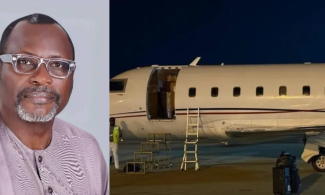
The aircraft, registered as T7-SEI, is a 21-year-old Bombardier Challenger 604 with Manufacturer Serial Number 5593. It was built in Canada in September 2004.
The private jet that lost its main cabin door shortly after taking off from Abuja on Thursday had suffered four flight-control failures in four months in 2005, forcing emergency diversions to destinations across Europe and the Middle East, official UK investigation records have revealed.
The aircraft, registered as T7-SEI, is a 21-year-old Bombardier Challenger 604 with Manufacturer Serial Number 5593. It was built in Canada in September 2004.
The jet is now associated with Shoreline Energy International, the oil and gas company founded by Nigerian businessman Kola Karim. Flight-tracking information lists the aircraft as operated by Empire Aviation San Marino and Triton Aviation, with flights between Lagos and Abuja under the callsigns DWC and MJE.
A SaharaReporters investigation of global aviation safety databases and aircraft photo archives found that the aircraft began its operational history under the US registration N604SC, registered to Bombardier Aerospace Corporation.
Within months, it was re-registered in Bermuda as VP-BJM and operated under the name Misty’s Bull for almost 19 years.
The aircraft appeared under the registration T7-SEI in San Marino in March 2024, with records identifying it as formerly registered VP-BJM. Shoreline acquired the jet in May 2024, according to aircraft records reviewed by SaharaReporters.
Four Flight-Control Failures In Four Months
According to the United Kingdom Air Accidents Investigation Branch (AAIB) Report No. 1/2008, which investigated incidents involving VP-BJM, serial number 5593, the aircraft suffered a series of flight-control failures between July and November 2005.
The first occurred on July 12, 2005, when the aircraft had accumulated just 113 flight hours and 79 landings.
During cruise, the stabiliser trim channel disengaged and could not be re-engaged. The trim-position indication also disappeared from the aircraft's primary Engine Indicating and Crew Alerting System (EICAS).
The crew diverted to Toulouse, France, where engineers found contamination on the motherboard of the Horizontal Stabiliser Trim Control Unit (HSTCU). The unit was replaced.
The second failure occurred on August 18, 2005, when the aircraft had accumulated 144 flight hours and 95 landings. Its technical log recorded a stabiliser trim runaway during final approach.
On September 14, 2005, the aircraft suffered a third failure, approximately five hours into a cruise flight. The stabiliser trim, autopilot pitch trim and mach trim systems failed. Although Channel 2 appeared to be engaged, it did not respond to manual commands, forcing the crew to divert to Beirut, Lebanon.
The fourth incident, on November 11, 2005, was particularly serious.
At 3:22 p.m., approximately eight nautical miles west of the Midhurst VOR in West Sussex, England, the aircraft experienced another stabiliser trim malfunction.
It had accumulated only 202 flight hours and 129 landings since leaving the factory.
According to the investigation, the stabiliser trim continued moving towards an almost full nose-down position despite the crew's attempts to apply nose-up trim commands.
The crew had to maintain prolonged, heavy aft pressure on the control column to prevent the aircraft from pitching down. With the autopilot unable to maintain the aircraft's attitude and the trim indication lost, the commander diverted to London Heathrow Airport for an emergency landing.
The subsequent investigation traced the failures to contamination inside the HSTCU, caused by moisture ingress. Investigators also found that the unit had not been properly secured in its avionics rack, identifying an installation error dating from the aircraft's early service life.
Manufacturer, Regulators Ordered Corrective Action
Following the incidents, Bombardier issued service bulletins, while Transport Canada issued airworthiness directives requiring inspections, cleaning and replacement of affected HSTCUs across the Challenger 604 fleet.
The measures covered aircraft serial numbers 5301 to 5665, a range that includes serial number 5593, now registered as T7-SEI.
After the corrective measures, the aircraft continued operating for almost two decades under the registration VP-BJM before being re-registered as T7-SEI and acquired by Shoreline in 2024.
Its more recent flight history, as reviewed by SaharaReporters, includes regular Lagos-Abuja services on October 9 and 10, 2026, as well as trips to London Luton Airport on November 29, 2024, and June 14, 2025.
On Thursday, October 15, 2026, the aircraft was operating as flight DWC052 from Abuja to Lagos when it suffered the latest incident.
Flight-tracking and air traffic control information reviewed by SaharaReporters indicates that the jet took off from Runway 22 at 16:17 UTC.
Approximately three nautical miles from the airport, while climbing through 3,000 feet, the crew declared a Mayday, reporting that the aircraft's door had opened in flight.
At 16:20 UTC, approach radar informed the control tower of the emergency. Airport fire, rescue and medical teams were placed on standby at positions A4 and A5.
At 16:29 UTC, the crew asked air traffic controllers whether they could visually confirm if the door was open.
The duty controller attempted to inspect the aircraft with binoculars but could not confirm the door's position because of the aircraft's location.
The jet returned to Runway 22 and landed safely at 16:34 UTC, approximately 22 minutes after take-off and 14 minutes after the Mayday call.
It was after landing that the controller observed that the aircraft had lost its main entry door entirely. The jet was subsequently taxied to the extension of the international apron and parked.
All nine people on board, comprising three crew members and six passengers, survived without injuries, according to the Director-General of the Nigerian Safety Investigation Bureau (NSIB), Captain Alex Badeh Jr., who confirmed the development on Friday.
The detached door was recovered from farmland near Abuja. A viral video showed farmers who reportedly found the door describing how it had fallen from an aircraft.
The NSIB said the door had been secured at its wreckage hangar and that an investigation had commenced to determine the circumstances surrounding its separation.
Questions Over Aircraft's Safety History
The discovery of the aircraft's earlier flight-control failures adds another dimension to questions surrounding the jet's operational history.
The 2005 incidents involved the aircraft's stabiliser trim system and were attributed to contamination and improper installation of a control unit. Thursday's incident involved the separation of the main cabin door.
There is currently no evidence establishing a connection between the earlier stabiliser trim failures and the recent door separation. The two incidents involved different aircraft systems and occurred more than two decades apart.
Nevertheless, the aircraft's history of four serious flight-control failures within four months of entering service is a significant part of its documented safety record.
The ongoing NSIB investigation is expected to establish the circumstances under which the main cabin door separated during Thursday's flight, including any relevant mechanical, maintenance or operational factors.



0 Comments
Leave a Comment